
Can you be offside without touching the ball?
Yes. A player who was in an offside position when a teammate played the ball can commit an offence by affecting an opponent's ability to play it. Blocking the goalkeeper's view or challenging a defender can be enough. Standing beyond the defensive line, by itself, is not an offence. Law 11 separates the player's position from what they subsequently do.
That is why following the ball can leave you watching the wrong player. The scorer may be onside and the pass may be legal, yet someone beside the goalkeeper can still cause the goal to be disallowed.
Where does the offside line come from?
Freeze the picture when a teammate plays or touches the ball. Look at the attacker's head, body and feet. To be in an offside position, a relevant part must be in the opponents' half and closer to their goal line than both the ball and the second-last opponent. Hands and arms do not count; being level is enough to stay onside. The FA's Law 11 sets out that position test.
Notice the word opponent. The goalkeeper usually stands closest to the goal, but has no special place in this calculation. If the keeper comes out, another player may be the last opponent. Counting only outfield defenders can give you the wrong line.
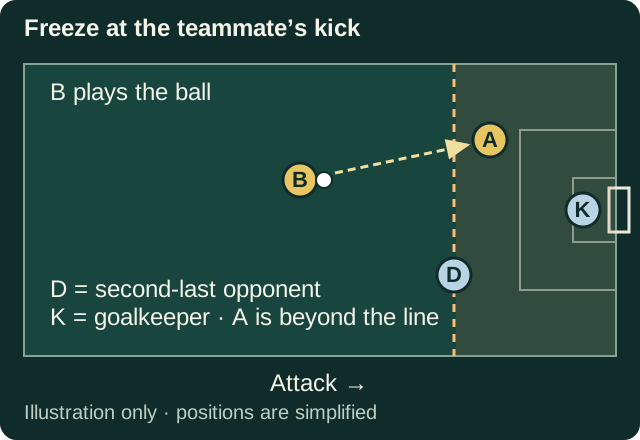
For an ordinary kick, the current law uses the first contact with the ball. A goalkeeper's throw is an exception: the reference point is release. These are position checks, not automatic whistles.
Why can two similar pictures produce different decisions?
Imagine a teammate shooting with attacker A already beyond the line. A never touches the shot in either of the following examples. Only A's involvement changes.
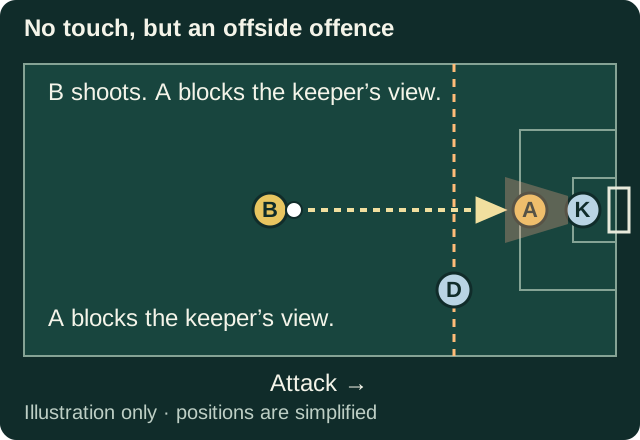
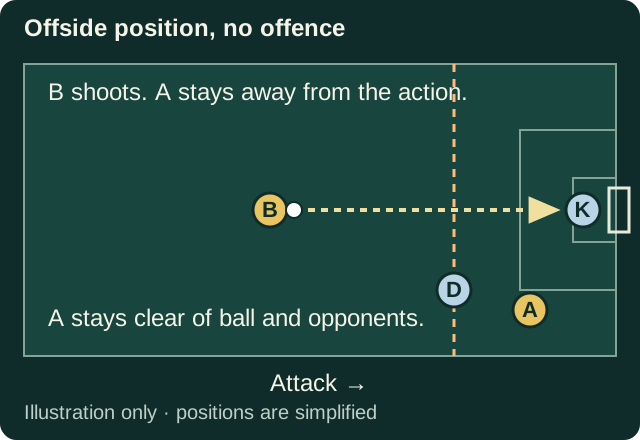
The second example is deliberately simple. In a match, a useful angle has to show the attacker's movement, the ball and the opponent being affected. A frozen television image may establish position while telling us little about interference.
Nor do officials need to prove that the goalkeeper would have saved the shot. In its Match Round 5 explanation, the Premier League says the question is whether the player's ability to play the ball was affected. A difficult shot can still involve an offside offence.
What if the attacker tries to touch it and misses?
A missed touch can matter. Under the Premier League's guidance, an attempt to play a nearby ball becomes an offence when it affects an opponent. A challenge for the ball also counts, as can an obvious action that clearly changes the opponent's ability to play it.
There must be a football action to assess. An attacker stretching towards a cross beside a defender presents a different question from an attacker jogging away on the far side of the box. Watch who has to react, what the attacker does and how close the ball is. Do not decide from the player's position alone.
Harry Maguire's part in a disallowed Manchester United goal provides a real example. At Fulham in November 2023, Christian Eriksen delivered a free kick, Alejandro Garnacho supplied Scott McTominay and McTominay scored. Maguire's attempt to reach the delivery from an offside position prompted the review. After checking his involvement at the monitor, referee John Brooks disallowed the goal. The Premier League's account explains why the scorer's position was not the whole decision.
Luis Díaz's involvement before Diogo Jota scored against Everton shows the other outcome. In Howard Webb's April 2025 explanation, Díaz initially stood in an offside position as James Tarkowski intervened. The officials found no challenge or attempt to play the ball by Díaz at that point. He later moved onside and supplied Jota. The goal stood.
The incidents reward watching the player away from the final touch. Maguire's attempt became part of the offence; Díaz's initial position did not, on its own, end that attack.
Does a defender's touch cancel the offside?
Sometimes. A defender can control the ball and make a poor clearance: the result being inaccurate does not automatically turn that action into a deflection. The current law asks whether the defender had control with an opportunity to pass, gain possession or clear. Time to react, a clear view and the ball's speed help officials judge that action.
A ricochet is different. So is a save. If a teammate shoots while an attacker is in an offside position, a rebound from the keeper or post does not give that attacker a fresh licence to score. A deliberate goal-saving block by an outfield opponent is also treated as a save. IFAB's explanation distinguishes these situations.
There is an order to the events, too. An attacker who has already interfered with an opponent cannot erase that offence by pointing to a subsequent defensive touch. Follow the action from the teammate's pass, not just the final rebound.
Can you be offside from a throw-in, corner or goal kick?
There is no offside offence when receiving the ball directly from any of those three restarts. Directly does the work: once a teammate touches the ball again, a new offside position may need checking. A short corner returned to its original taker can therefore produce an offside offence. The FA's Law 11 explains the restart exceptions.
What should you watch on the next replay?
Start at the teammate's contact with the ball. Find the second-last opponent and check the ball's position as well. Then leave the freeze-frame and watch the attacker's next action: a touch, a challenge, a blocked view or another clear effect on an opponent. Finally, check whether a defender controlled the ball, merely deflected it or made a save.
That sequence explains more than a line drawn across the pitch. The line answers where the attacker was. The moving picture answers whether the attacker committed an offence.
Read more Premier League explanations and stories, or explore our penalty and set-piece guide for another part of the game where the player away from the ball matters.