
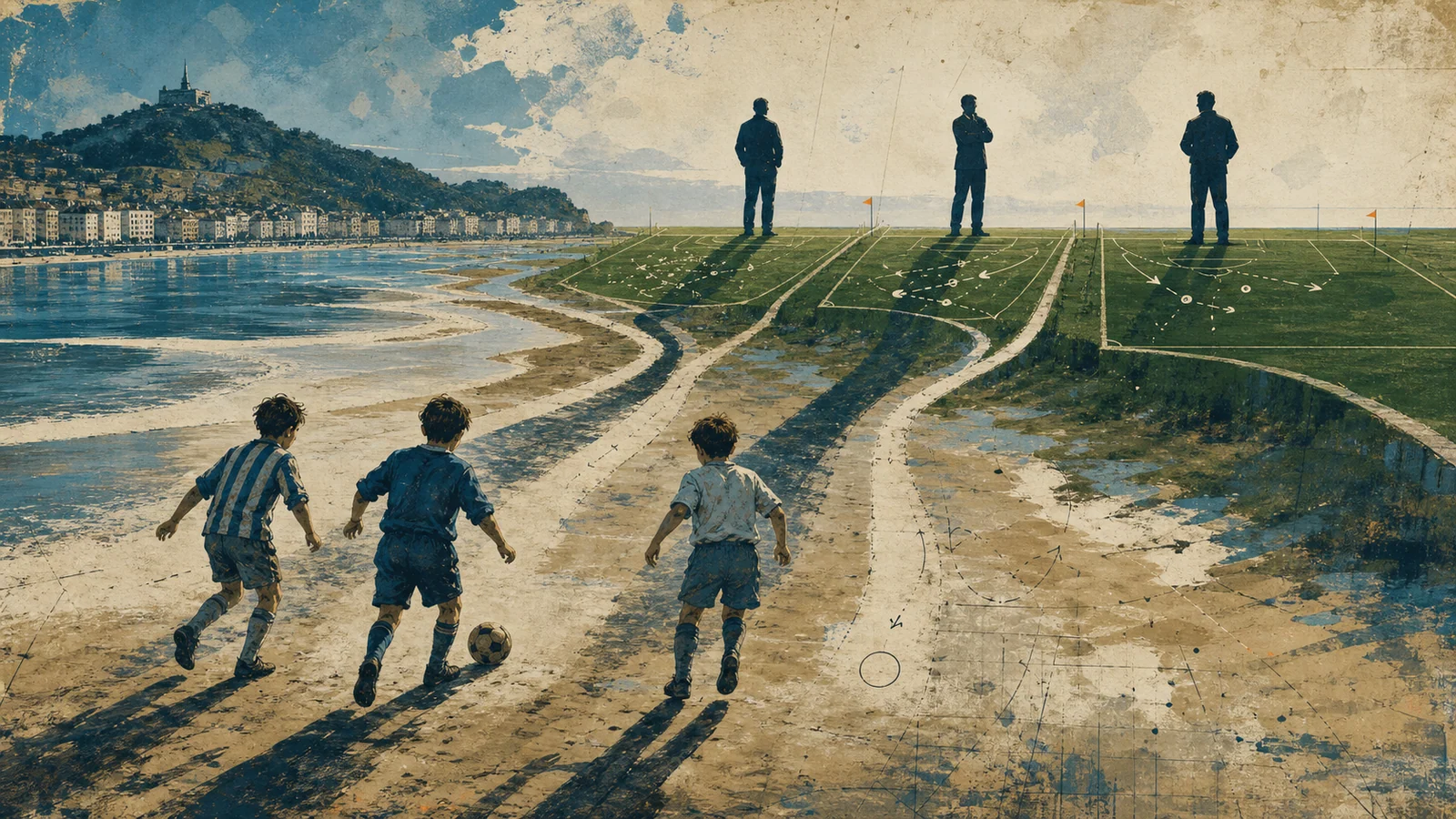
What connects the managers of Arsenal, Liverpool and Chelsea?
Mikel Arteta, Xabi Alonso and Andoni Iraola all came through Antiguoko Kirol Elkartea, an amateur youth club in San Sebastián. In the 2026/27 Premier League, Arteta manages Arsenal, Alonso manages Chelsea and Iraola manages Liverpool. All 3 have managed to carve out their own distinct coaching style: Arteta seeks control through structure, Alonso through movement and Iraola through disorder.
FootieGuide's prediction: Liverpool are the surprise narrow title pick, Chelsea are the biggest gainers and Arsenal remain the most complete team but wilt under the pressure of defending the crown.
For more premier league insights, read the Premier League archive. For more current season stats, visit the Fantasy hub.
The 2026/27 Premier League begins with a record managerial reset. At its centre are three men who first learned football together on the beaches and gravel pitches of San Sebastián.
There are managerial changes, and then there is an entire league changing its accent.
A record nine Premier League clubs begin 2026/27 with new managers. Manchester City have replaced Pep Guardiola with Enzo Maresca. Liverpool have turned to Andoni Iraola after dismissing Arne Slot. Chelsea have handed Xabi Alonso a four-year contract. Marco Rose, Pierre Sage, Álvaro Arbeloa, Gary O’Neil, Oliver Glasner and Matthias Jaissle complete the extraordinary turnover.
Manchester United’s Michael Carrick and Tottenham’s Roberto De Zerbi are also entering their first full seasons, meaning five of the traditional “Big Six” are effectively beginning new projects. Arsenal are the lone point of stability. Mikel Arteta, appointed in December 2019, is now the Premier League’s longest-serving manager and the only current one to have won its title.
Yet the most remarkable connection between these new projects began more than three decades ago.
Arteta, Alonso and Iraola - all born within seven months of one another - grew up around San Sebastián and passed through the same amateur youth club: Antiguoko Kirol Elkartea. They wore the same pale-blue shirt, trained under some of the same coaches and belonged to one exceptional generation of boys born in 1981 and 1982.
Now they manage Arsenal, Chelsea and Liverpool.
A Premier League title race involving billions of pounds, global scouting networks and some of the world’s best footballers can be traced back to a neighbourhood bar, a beach governed by the tide and a pitch made of gravel.
Antiguoko: the San Sebastián football club founded in a bar
Antiguoko was created in 1982, just under a month before that summer’s World Cup began in Spain.
Its founders met at Bar Juanito in San Sebastián’s Antiguo neighbourhood. They concluded that their existing local team was unlikely to achieve much at senior level, so they would invest everything in developing children instead.
For the club’s first 13 years, meetings were held in neighbourhood bars such as El Antzara and Café Golden. There was no permanent home and no trophy cabinet. When the children began winning competitions, their trophies were carried from one local bar to another so that the community could see them.
There was not enough available playing space in San Sebastián, so Antiguoko used the city’s beaches.
When the tide withdrew at La Concha and Ondarreta, parents and coaches marked out pitches on the hard sand and dragged goal frames from storage. Matches continued until the Cantabrian Sea returned and reclaimed the playing surface.
The club eventually moved to the Municipal Berio pitches. Today they are artificial turf. When Arteta, Alonso and Iraola arrived, they were gravel.
Falling hurt. The old Mikasa footballs left marks on children’s legs. Playing on grass was considered a reward. Technique was not something taught in pristine academy conditions; it was developed on surfaces that punished a loose touch and made every physical duel memorable.
That environment helps explain Antiguoko’s unusual footballing identity. The ball stayed on the ground. Players were expected to think quickly, compete for everything and accept that the collective mattered more than the individual.
Arteta and Alonso were also childhood neighbours on Calle Matia. They played on the beach before later finding themselves living near one another again on Merseyside; Alonso representing Liverpool and Arteta playing for Everton. Xabi’s father, Periko Alonso, had won consecutive La Liga titles with Real Sociedad before becoming a coach, so football was already part of the family language.
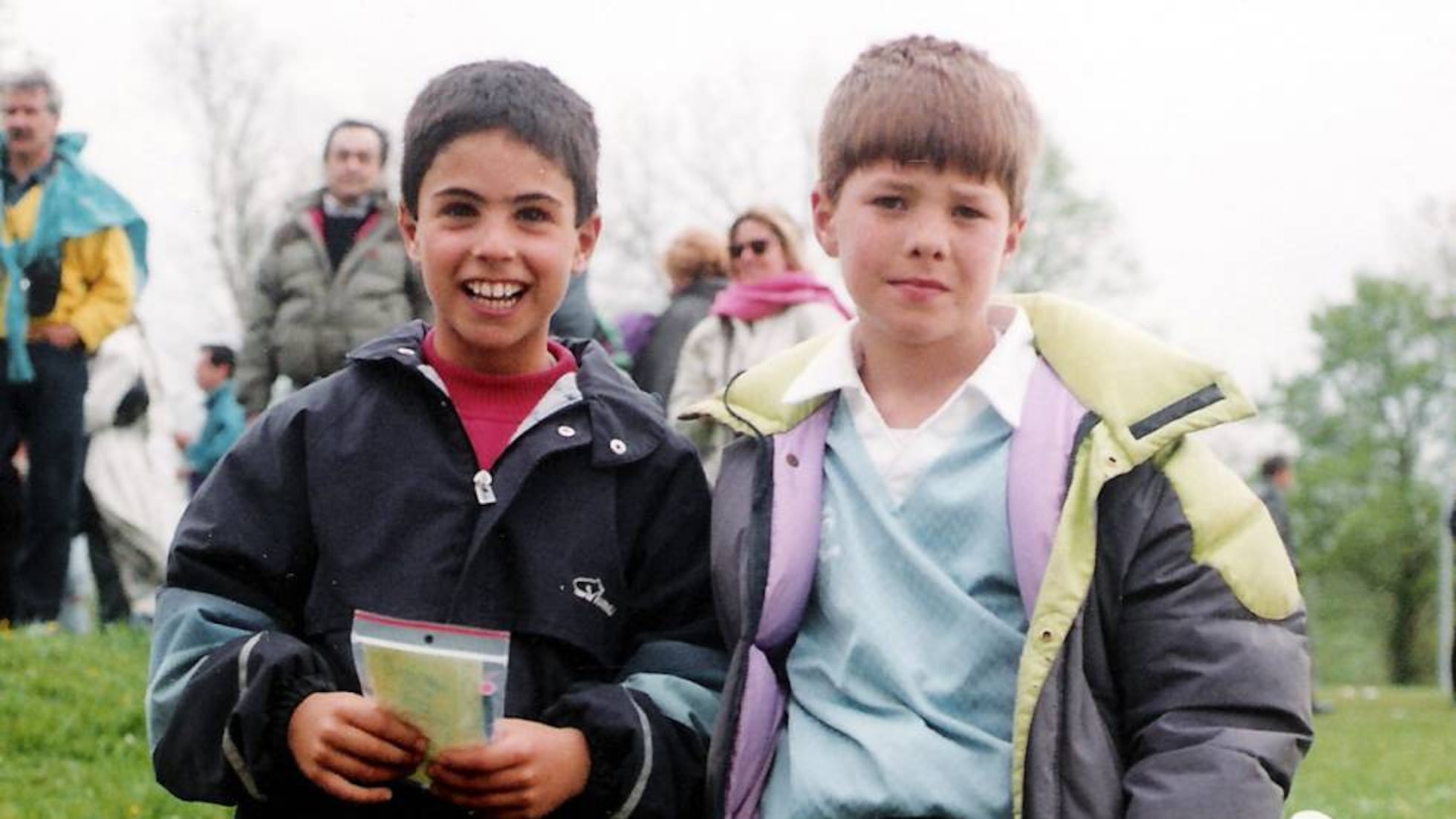
Mikel Arteta and Xabi Alonso together as children at Antiguoko. Photo published by El País.
Long before Liverpool appointed one Antiguoko graduate as manager and watched another join Chelsea, the club had sent a delegation to San Sebastián to study how this tiny amateur academy kept producing elite footballers.
The Antiguoko neighbourhood “Dream Team”
The Antiguoko group containing Arteta, Alonso and Iraola was genuinely exceptional; beyond the rose-tint lenses of nostalgia and hindsight.
In the summer of 1994, 12-year-old Arteta and Iraola left Spain for the first time. They travelled with teammates and family members on a 20-hour bus journey to a tournament in the Netherlands.
Other trips followed across the world to France, Italy, Sweden and even Mexico. Antiguoko often returned with trophies.
This neighbourhood side beat Real Sociedad’s academy 5–0 and scored four against Real Madrid. Its members included future Spain striker Aritz Aduriz, Xabi’s brother Mikel Alonso and numerous players who later reached professional football.
Álvaro Parra, the team’s centre-back, eventually described them as being “like the Dream Team.” At the time, they were simply schoolchildren travelling together, winning matches and enjoying themselves.
The former teammates later created a WhatsApp group. They discussed one another’s careers and rediscovered the jokes and memories that only childhood teammates can share. One of them admitted supporting Real Madrid because Alonso was playing there - an often unforgivable act in San Sebastián.
But what do their old teammates and coaches remember about the three future managers?
Three future Premier League managers, three early clues
Mikel Arteta: the leader everyone noticed
Arteta was the obvious prodigy.
He played as a daring No. 10, was comfortable with either foot and was unusually competitive. Roberto Montiel, one of his Antiguoko coaches, remembers Arteta receiving the ball against Real Sociedad, dribbling through almost the entire team and finishing with an audacious scoop. The move reminded Montiel of something Lionel Messi might produce.
Arteta was small, but loud, extroverted and naturally influential. He understood situations quickly and constantly searched for solutions. Montiel’s blunt assessment of his talent was that “his quality was brutal.”
At 15, Arteta left San Sebastián for Barcelona. Even then, he did not forget Antiguoko. After signing his first boot agreement with Adidas, he asked the company to provide training kits for his old club.
In March 2023, Arteta returned to Antiguoko on his 41st birthday and took his sons to watch the under-15s face Real Sociedad. He stayed afterwards for photographs despite having a flight back to London that afternoon.
The boy who wanted to influence every match became the manager who gradually assumed influence over almost every part of Arsenal.
Xabi Alonso: the game was already in his blood
Alonso’s intelligence surprised nobody.
He came from the older 1981 group but played within the same exceptional Antiguoko generation. Former teammates recall a player who could be placed under pressure and still find the right solution. Unlike Arteta’s more visible leadership, Alonso seemed to organise matches quietly.
He had also been observing coaching almost from birth. His father, Periko, played for Spain at the 1982 World Cup, won three league titles and later managed Real Sociedad. Xabi would attend his sessions and absorb how teams were constructed.
That calm authority followed Alonso throughout his playing career. He rarely appeared hurried because he had normally understood the next phase of play before everyone else.
Of the three Antiguoko graduates, Alonso reached the highest level as a player. At club level, he won the Champions League with both Liverpool and Real Madrid, the La Liga title in Spain and three Bundesliga titles with Bayern Munich, establishing himself as one of his generation’s outstanding deep-lying midfielders. Internationally, he earned 114 caps for Spain and was central to the side that won UEFA Euro 2008, the 2010 FIFA World Cup and UEFA Euro 2012—an era of achievement few players in football history can match.
At Bayer Leverkusen, the same quality became visible from the technical area. Alonso inherited a club in a relegation battle in October 2022. In 2023/24, Leverkusen won the first Bundesliga title in their history without losing a league match, added the DFB-Pokal and suffered only one defeat across 53 games—the Europa League final against Atalanta.
Andoni Iraola: the quiet problem-solver
Iraola was the least obvious future manager.
He was shy, academically gifted and technically excellent. At Antiguoko he played on the right wing rather than in the full-back position where he would eventually make more than 500 appearances for Athletic Club.
During one training exercise, Montiel kicked the ball high into the air and sent three players to dispossess Iraola. He controlled it and protected possession from all three for more than a minute. The lesson was simple: when a match became difficult, Iraola could be trusted to solve the problem.
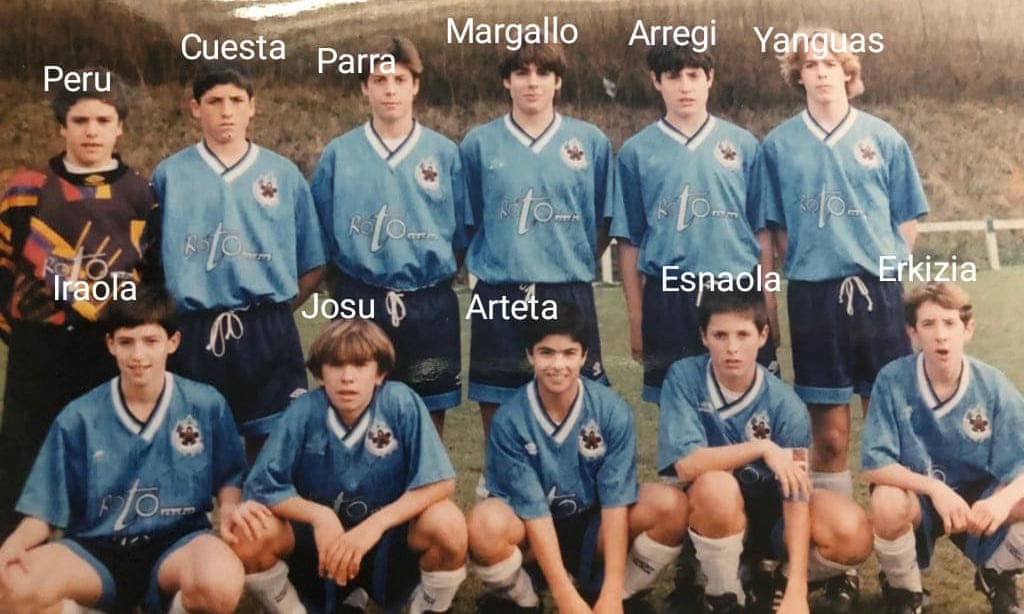
Mikel Arteta and Andoni Iraola line up for Antiguoko. Photo published by The Guardian.
His coaching career eventually completed the circle. While studying for his UEFA Pro Licence, Iraola returned to coach Antiguoko’s under-18s.
He later took Rayo Vallecano into La Liga, defeated both Barcelona and Real Madrid, and transformed Bournemouth across three seasons. His final campaign ended with an 18-match unbeaten league run, sixth place and the first European qualification in Bournemouth’s history.
Xabi Alonso and Liverpool: the road not taken
Of the three journeys into the 2026/27 season, Alonso’s contains the greatest emotional contradiction.
He joined Liverpool from Real Sociedad in the summer of 2004. Over five seasons, he made 210 appearances, scored 19 goals and won the Champions League, FA Cup and UEFA Super Cup.
His place in Liverpool history was secured during the 2005 Champions League final in Istanbul. With Liverpool having recovered from 3–0 down against AC Milan, Alonso took a penalty to complete the comeback. Dida saved it, but Alonso drove in the rebound to make it 3–3. Liverpool went on to win the shootout.
He was elegant, intelligent and immediately understood by Anfield. Even after leaving for Real Madrid in 2009, he retained the affection of Liverpool supporters.
That is why January 2024 felt like the beginning of a homecoming.
When Jürgen Klopp announced that he would leave Liverpool at the end of the season, Alonso became the reported frontrunner to replace him. Klopp publicly described him as the “standout” coach of the emerging generation. Liverpool supporters could see the story almost writing itself: the midfielder who had helped deliver Istanbul returning to lead the club from the dugout.
By March, however, Alonso had decided to remain at Leverkusen. He called it the “right place to be for me as a young coach.” The Liverpool possibility ended, and Alonso completed Leverkusen’s historic unbeaten domestic double.
The possibility surfaced emotionally again after his brief Real Madrid tenure ended in January 2026. But the timing was wrong.
Chelsea announced Alonso’s appointment on May 17, with his four-year contract beginning on July 1. Liverpool did not dismiss Slot until May 30. Iraola was appointed on June 4. By the time the Liverpool position officially reopened, Alonso had already committed himself to Stamford Bridge.
Liverpool eventually got an Antiguoko manager - just not the one many supporters had spent two years pining for.
Alonso will return to Anfield in blue rather than red. Standing in the opposite technical area will be another boy who learned the game on the same gravel pitches.
One Antiguoko football education, three tactical languages
The shared Antiguoko training regime has produced three very different managers. Antiguoko gave them the same alphabet; each developed different handwriting.
Arteta seeks control through structure. Arsenal’s positioning, pressing and set plays are repeatedly rehearsed. His team attempts to remove uncertainty from matches and slowly restrict the opponent’s available choices.
Alonso seeks control through movement. His best Leverkusen team used a back three, aggressive wing-backs and two narrow attacking midfielders. It circulated possession patiently, invited opponents forward and then exploited the spaces they surrendered. But Alonso could also become pragmatic, as demonstrated when Leverkusen beat Bayern Munich 3–0 with only 39 per cent possession in February 2024.
Iraola seeks control by creating disorder. His teams press high, attack vertically and attempt to reach the final third before the opposition can reorganise. Across his three Bournemouth seasons, no Premier League team produced more shots after regaining possession in the attacking third, while Bournemouth moved the ball upfield faster than anyone else.
That makes Iraola a natural cultural fit for Liverpool. His football represents a swing back towards the aggression and verticality associated with Klopp after two more measured seasons under Slot. It is not a carbon copy though. Klopp’s best teams became far more comfortable dominating possession but Anfield will not need to be taught how to love Iraola’s intensity.
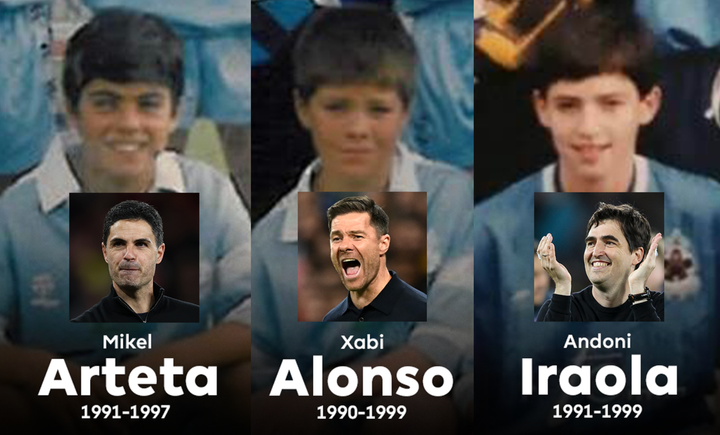
The three Antiguoko graduates as boys and as Premier League managers. Image published by the Premier League.
Alonso’s task is different. Chelsea need an identity, but first they need order. He inherits a large, talented squad that has experienced repeated tactical and managerial changes. His preferred 3-4-3 should place Cole Palmer and Morgan Rogers close to goal, with João Pedro capable of dropping away from the forward line and linking play.
There is also a historical echo. Chelsea’s last Premier League title came under Antonio Conte in 2016/17, using a back-three system during a season without European football. Alonso will have the same uninterrupted midweeks to teach his methods. Could he?
2026/27 Premier League title race: how Arsenal, Chelsea and Liverpool compare
Arsenal: the burden of defending the title
Arsenal may still begin as the most complete team of the three. They have the clearest structure, the strongest continuity and a manager whose ideas are already embedded throughout the club.
But retaining a Premier League title is a different challenge from winning one.
Arsenal should start strongly, powered by continuity and the confidence of champions. But opponents will now treat them as the benchmark, prepare more specifically for Arteta’s structured possession and set-piece routines, and eventually expose enough familiar patterns to make the title defence falter.
Only Sir Alex Ferguson, José Mourinho and Pep Guardiola have successfully defended the trophy in the Premier League era. The most recent team to do it was Guardiola’s Manchester City in 2023/24, when they completed an unprecedented fourth consecutive title.
Arteta is trying to enter that company immediately after finally ending Arsenal’s long wait. The champions will now be studied differently, approached differently and expected to win every week. Their stability keeps them in the race, but the emotional and tactical demands of repeating may prove just too much.
Chelsea: the biggest transformation
Chelsea should make the greatest leap.
Alonso inherits enormous talent, but his real advantage is time. With no European football, he will have uninterrupted training weeks to teach his positional system, settle his preferred combinations and turn a collection of expensive players into something coherent.
That same absence of European distraction helped Antonio Conte impose a new structure during Chelsea’s 2016/17 title season. Alonso has the intelligence to use it similarly, even if winning the league in his first year may be one step too far.
Chelsea should move from 10th into genuine title contention. Alonso will make them look like a team again—and perhaps leave supporters wondering what might have happened had he returned to England in Liverpool red rather than Chelsea blue.
Liverpool: a return to themselves
Liverpool are the narrow pick.
Iraola does not need to invent an identity that Anfield has never seen. He needs to revive one it already understands.
His football is built around furious pressing, direct attacks and turning opposition possession into panic. The Premier League itself has described his approach as a return to Klopp-style “heavy-metal football”: high pressure, frantic energy and verticality. At Bournemouth, his teams ranked first in the league for both direct attacking speed and shots created after final-third turnovers across his three seasons.
That makes Iraola unusually well suited to correcting Liverpool’s disappointing previous campaign. The club, the crowd and much of the squad were shaped by Klopp’s belief that intensity could become a form of control. Iraola speaks the same footballing language.
There will be chaos. Liverpool may concede too many goals and occasionally struggle against teams that refuse to open the game. But their transition should be faster than Chelsea’s, while Arsenal carry the heavier psychological burden of defending the title.
Prediction: Liverpool, Chelsea and Arsenal
- Liverpool
- Chelsea
- Arsenal
Chelsea will be the season’s biggest improvers. Arsenal will remain one of England’s best teams. But Liverpool, reawakened by a manager whose football feels immediately at home at Anfield, will edge Alonso’s Chelsea in the final weeks.
More than three decades after Arteta, Alonso and Iraola shared coaches, buses, beaches and unforgiving gravel pitches, the three boys from Antiguoko will arrive at the closing weeks of a Premier League season with the title still between them.
Liverpool supporters once imagined Alonso returning to Anfield to lead them. Instead, he will arrive there in Chelsea blue, attempting to take the trophy from another of his childhood teammates.
And when the gravel finally settles, it will be Iraola who finishes first.
What to read next
Track the matchday context behind this story in the Fantasy hub, or browse the Premier League story archive for the next long-form football feature.