
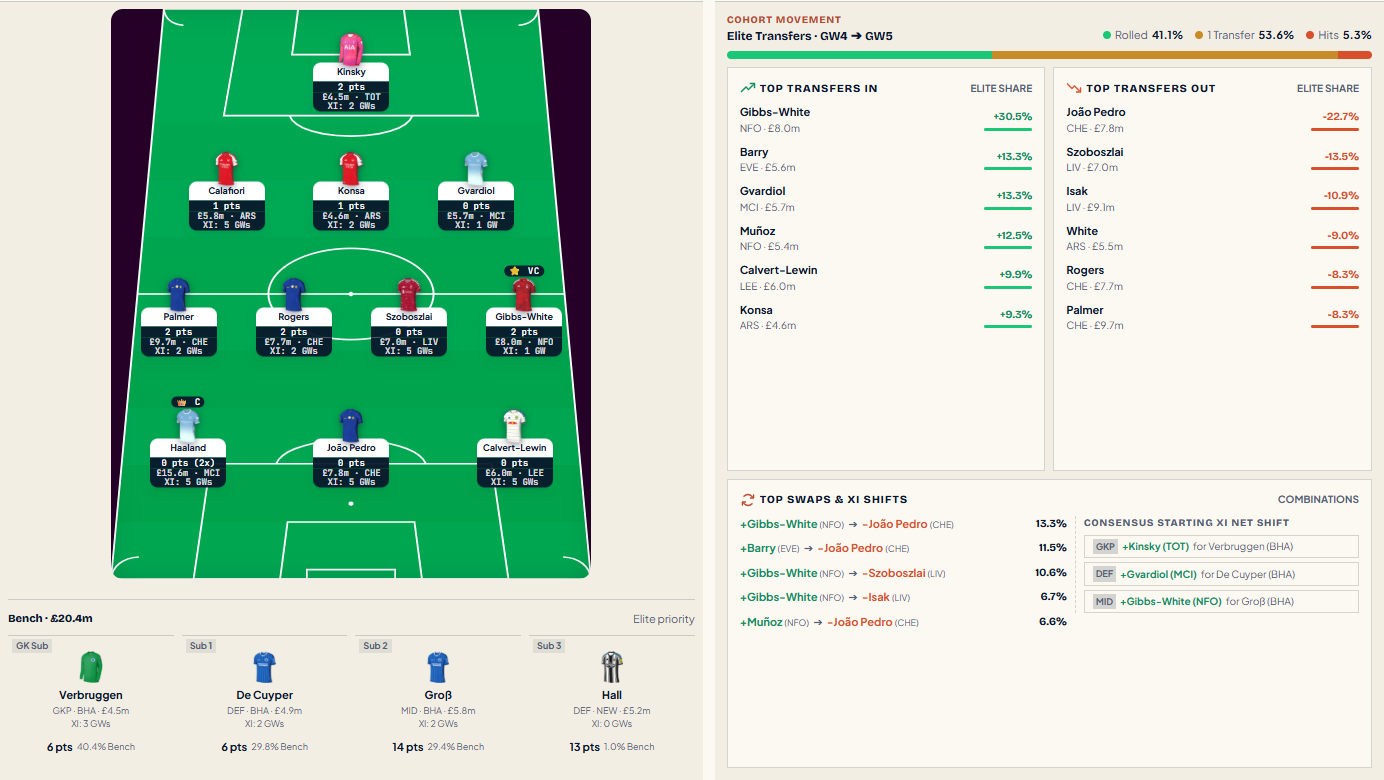
What is FootieGuide's Legends Consensus XI?
FootieGuide's Legends Consensus XI combines the selections of tracked FPL managers with at least five top-10,000 finishes into a 15-player squad. The Fantasy dashboard shows the starting XI and bench, with captaincy votes, squad ownership and transfers alongside them.
For Gameweek 5, 90.3% of the Legends pool handed the armband to Haaland. Their transfer decisions take a little more reading. João Pedro was the most common sale, yet 75.0% of the cohort still owned him.
The useful question for a João Pedro owner is which replacement improves their own XI. Following an FPL experts team gives you several candidates to examine and an ownership figure to put the sales in context.
Who qualifies for the Legends pool?
The entry requirement is at least five recorded season finishes inside the overall top 10,000. FootieGuide checks that rule against the manager histories in its database. Each qualifying manager with available gameweek picks contributes equally to the consensus.
This gives the group a history of repeated high finishes. The current season's top 10,000 is a separate group, selected by points earned so far. Early in a season, a few excellent weeks can put a manager near the top; the Legends criterion requires strong results across several seasons.
The pool can grow as more qualifying histories are found. The GW5 refresh includes picks for every member across GW1 to GW5. The figures used below are preserved in our 20 September GW5 snapshot, taken at 09:42 UTC.
How the consensus squad is built
Selection starts with squad ownership. The generator fills the usual 15 places: two goalkeepers, five defenders, five midfielders and three forwards, allowing a maximum of three players from a club. More frequently owned players have priority, with starting selections used to break ownership ties.
From that squad, it chooses the legal formation whose players have the highest combined starting-selection count. The goalkeeper follows the same starting-frequency principle. For GW5, the resulting XI plays 3-4-3.
Captaincy is drawn from the selected starters. The player with the most captaincy votes gets the armband; the next player in that vote supplies the consensus vice-captain. The bench contains the remaining goalkeeper and outfield players, with the outfield order based on bench-selection frequency and ownership.
This creates a composite team that can change at each refresh. Its GW5 squad costs £102.8m at the official player prices used in the snapshot. When considering similar moves, use your own selling prices and money in the bank to work out what you can afford.
The points history adds the selected players' official FPL scores, including the captain's multiplier. A chip is applied to the consensus when more than half of the active cohort uses it. The displayed Best Rank is the lowest observed official rank matching the same points total among the histories checked. Each history row records the score of that gameweek's generated team.
How can I learn from elite FPL managers?
Compare your squad with elite FPL managers. Use FootieGuide's Legends Consensus XI to examine ownership and captaincy, then assess transfers against your own plans. Start with the decisions where your team differs most and look for the football reason behind each choice.
Ownership gives you a starting point
An FPL template is the group of players commonly held across a set of teams. Here, elite ownership means the share of the Legends pool that owns a player. In GW5, Haaland had 93.0% ownership and Calafiori had 83.8%.
If your squad is missing a heavily owned player, work through the decision. Would buying him improve your next few starting XIs? Does his price force a weaker choice elsewhere? Perhaps you already have a player you prefer for the coming fixtures. Writing down that reason gives you something useful to revisit after the matches.
The XI gameweek count shows how often a player has appeared in the Legends starting team this season, including the current gameweek. Bench appearances are excluded.
The starting and bench figures add another layer. A player can have substantial squad ownership while many managers leave him out of their XI that week. Before treating ownership as a recommendation to start someone, check how the cohort used him.
Captaincy shows the strength of agreement
Haaland received 90.3% of the cohort's captaincy votes in GW5. That is a clear indication of how this group approached the armband. A captaincy choice spread between several players would deserve a different reading.
Use the vote to test your own shortlist. If you prefer another captain, check his expected minutes and scoring opportunities against Haaland's. The GW5 preview covers that week's fixtures. For later gameweeks, repeat the comparison with fresh team news.
Transfers need the ownership figure beside them
Gibbs-White entered 30.5% of the cohort's squads between GW4 and GW5. His final ownership was 40.9%. That combination identifies a player whose place in these teams had expanded sharply.
João Pedro illustrates the other side. He left 22.7% of squads, the largest outgoing share, while his remaining ownership was 75.0%. An owner considering selling him would want to investigate the latest availability news and the possible replacements. The headline sales figure by itself leaves much of that decision unanswered.
The transfer lists compare each manager's squad across consecutive gameweeks. Wildcard and Free Hit changes are included. The swaps panel records incoming and outgoing players appearing together in those changes; a manager replacing several players can contribute several pairings.
For your own transfer, trace the whole move. Check the incoming player's likely starts, how he fits the next few fixtures and what happens to the player you would otherwise bench. Our set-piece guide can help when penalties or dead-ball duties affect the comparison.
A quiet week is worth noticing
In GW5, 41.1% of the cohort made no transfer. Another 53.6% made transfers without a points hit, and 5.3% took a hit.
Before spending a transfer, set out the XI you can already field. If your likely starters are available and have fixtures you are comfortable with, consider what saving the transfer would let you do next week. If you have an immediate problem, compare the replacement with your first substitute as well as the player being sold.
The same attention to your own squad applies to chips. In this sample, 86.7% used no chip. Wildcard usage was 7.1%, and Free Hit usage was 4.8%. A Bench Boost decision depends on the players on your bench; a Wildcard decision depends on how many changes your team needs.
Reading the GW5 picture together
The dated snapshot brings these observations into one view. Every percentage below refers to the same Legends cohort.
| GW5 observation | Cohort figure | What to examine in your team |
|---|---|---|
| Haaland captaincy | 90.3% | Your captain's fixture and expected minutes |
| Gibbs-White entering squads | 30.5% | His role and the fixtures ahead |
| João Pedro leaving squads | 22.7% | Availability news and the replacement you can afford |
| João Pedro still owned | 75.0% | The case for keeping him alongside the case for selling |
| No transfer made | 41.1% | The XI you can field before making a move |
| No chip used | 86.7% | Whether your own squad needs a chip this week |
The XI itself changed in three places from GW4: Kinsky replaced Verbruggen in goal, Gvardiol took De Cuyper's defensive place, and Gibbs-White came in for Groß. Those are changes to the generated starting team. Both the incoming and outgoing players can still belong to its full squad, as they do in this example.
Using the dashboard before your next decision
Begin with the gameweek label and update time. The consensus uses published picks after that gameweek's deadline. During GW5, those selections give you a reference for planning GW6; fresh injuries and subsequent matches can change the decision before the next deadline.
Open the Legends Consensus XI beside your own team and choose one decision to examine. It might be a captain you are uncertain about or a midfielder you have been meaning to replace. Check his ownership, follow the transfer movement and look at the alternatives your budget allows.
Then write down the move you would make and the reason for it. After the next gameweek, return to that reason. Did the player get the minutes you expected? Was his role what you had anticipated? The answer gives you something specific to improve when you pick the following team.